Telelore

Change of Habit

  • 1969
  • 1 h 33 min
  • United States

Overview

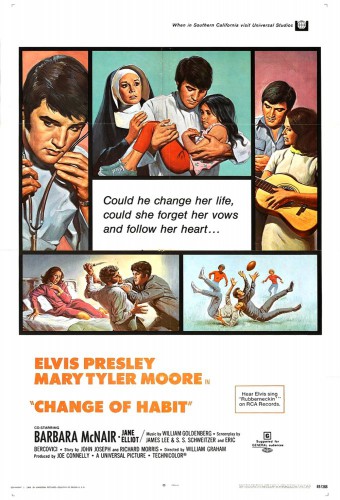
Dr. John Carpenter heads a clinic serving an underprivileged community in a major metropolis with an ethnic Puerto Rican population. He is surprised to be offered assistance by three women. Unknown to him, the three are nuns in street clothing who want to aid the community but are afraid the local residents might be reluctant to seek help if their true identities were known. The nuns are also facing opposition from the rude and arrogant priest Father Gibbons from the local parish. Dr. Carpenter and the nuns are shown dealing with non-verbal autistic girl Amanda, severely stuttering teenager Julio Hernandez and a man beaten by loan shark enforcers. The nuns at times are sexually harassed by loiterers and one nun, Sister Michelle Gallagher, suffers as an attempted rape. Dr. Carpenter falls for Sister Michelle but her true vocation remains unknown to him. She also has feelings for Dr. Carpenter but is reluctant to leave the order. The film concludes with Sister Michelle and Sister Irene entering a church where Dr. Carpenter is singing to pray for guidance to make her choice.

Runtime
1 h 33 min
Released
1969, Worldwide
Countries
United States
Original language
English

Release history

  1. Worldwide

Cast and crew

7See all credits

Videos and photos

Photos

Production and reception

See all production notes

Production

By 1969, Elvis Presley's future in Hollywood was under threat. Although still financially successful, mainly due to the "make 'em quick, make 'em cheap" attitude of Presley's manager Colonel Tom Parker, Presley's films had been making less profit in recent years. When Parker had struggled to find any studio willing to pay Presley's usual $1,000,000 fee, he struck a deal with NBC to produce one feature film, and a TV special entitled Elvis. NBC would pay Presley $1,250,000 million for both features, and Parker was happy in the knowledge that he was still able to earn $1,000,000 for his client.

Reception

A. H. Weiler of The New York Times reviewed the film on a double bill with House of Cards and noted that both were "merely exemplary of professional technique and dialogue rather than memorable characterization and emotion." Variety wrote that "its intriguing idea has a well-enough-constructed plotline to flesh out its premise for good family fare ... Presley displays his customary easy presence."

Loading similar titles

More like this

Where to watch

Nothing here yet

Discuss

Nothing here yet