
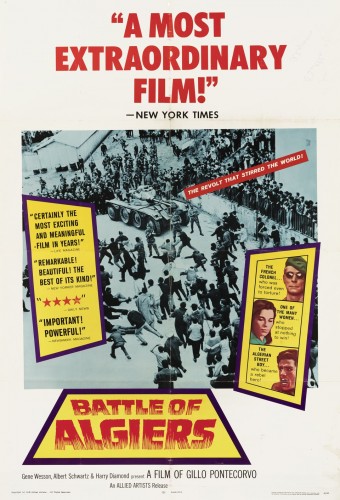
The Battle of Algiers
Original title: La Bataille d'alger
- 1966
- 1 h 57 min
- Italy, Algeria
Overview
The Battle of Algiers opens in 1957 in the capital city of French Algeria. After being tortured, one of Ali la Pointe's (Brahim Hadjadj) compatriots reveals Ali's hideout to the French Army. The Army raids Ali's home and tells him that he is surrounded and the "organization" is finished. The film then flashes back to 1954. The Battle of Algiers reconstructs the events that occurred in the capital city of French Algeria between November 1954 and December 1957, during the Algerian War of Independence. The narrative begins with the organization of revolutionary cells in the Casbah. Because of partisan warfare between the Algerian locals and pieds-noirs (ethnic Europeans born in Algeria), in which both sides commit acts of increasing violence, France sends French Army paratroopers to the city to fight against and capture members of the National Liberation Front (FLN). The paratroopers are depicted as neutralizing the whole of the FLN leadership through either assassination or capture. The film ends with a coda depicting nationalist demonstrations and riots, suggesting that although France won the Battle of Algiers, it lost the Algerian War. The tactics of the FLN guerrilla insurgency and the French counter insurgency, and the uglier incidents of the war are depicted. Both colonizer and colonized commit atrocities against civilians. The FLN commandeered the Casbah via summary execution of Algerian criminals and suspected French collaborators; they commit terrorism, including actions like the real-life Milk Bar Café bombing, to harass Europeans. The security forces resort to killings and indiscriminate violence against the opposition. French paratroops are depicted as routinely using torture, intimidation, and murder. Pontecorvo and Solinas created several protagonists in their screenplay who are based on historical war figures. The story begins and ends from the perspective of Ali La Pointe, a petty criminal who is politically radicalized while in prison. He is recruited by FLN commander El-Hadi Jafar, played by Saadi Yacef, who was a veteran FLN commander. Lieutenant-Colonel Phillippe Mathieu, the paratroop commander, is the principal French character. Other characters are the boy Little Omar, a street urchin who is an FLN messenger; Larbi Ben M'hidi, a top FLN leader who provides the political rationale for the insurgency; and Djamila, Zohra, and Hassiba, three FLN women urban guerrillas who carry out a terrorist attack. The Battle of Algiers also features thousands of Algerian extras. Pontecorvo intended to have them portray the "Casbah-as-chorus", communicating with chanting, wailing, and physical effect.
- Original title
- La Bataille d'alger
- Runtime
- 1 h 57 min
- Released
- 1966-08-31, Worldwide
- Countries
- Italy, Algeria
- Original language
- English
- Companies
- Netflix, RCS MediaGroup
Release history
- Worldwide
- Italy
- Algeria
- United States


Videos and photos
Photos


Quotes
See all quotesCouldn't you have talked sooner? It would've gone easier for you.
Read the full quoteFrench Interrogator
[handcuffed, walking to the guillotine] God is great! God is great! Long Live Algeria! Long Live Algeria! Long Live Algeria! Long Live Algeria! Long Live Algeria! Long Live Algeria!
Read the full quotePolitical Prisoner
Remember, we are at war against colonialism. A strong army has occupied our country for 130 years. This is why the FLN has to make decisions concerning the civil life of the Algerian people. With this marriage we fulfill…
Read the full quoteFLN Official
Ben M'Hidi: Jaffar says you weren't in favor of the strike.
Ali La Pointe: No, I wasn't.
Ben M'Hidi: Why not?
Ali La Pointe: Because we were ordered not to use arms.…
Read the full quoteJournalist: M. Ben M'Hidi, don't you think it's a bit cowardly to use women's baskets and handbags to carry explosive devices that kill so many innocent people?
Ben M'Hidi: And doesn't it seem to you even more cowardly…
Read the full quoteCol. Mathieu: What were they saying in Paris yesterday?
Journalist: Nothing. Sartre's written another article.
Col. Mathieu: Will you kindly explain to me why the Sartres are always born on the other side?
Journalist: So…
Read the full quote
More like this
Where to watch
Nothing here yet
Discuss
Nothing here yet