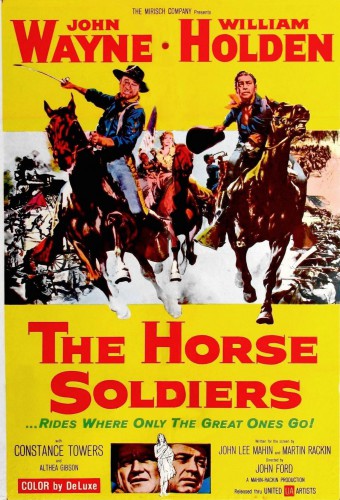
A Union cavalry brigade led by Colonel John Marlowe — a railroad construction engineer in civilian life — is sent on a raid behind Confederate Army lines to destroy railroad track and the Confederate supply depot for Vicksburg at Newton Station. Newly assigned Major Henry Kendall, a regimental surgeon who is torn between duty and the horror of war, is constantly at odds with Marlowe.
While the raiders rest overnight at Greenbriar Plantation, Miss Hannah Hunter, the plantation's mistress, acts as a gracious hostess to the unit's officers, hosting a dinner for them and exaggerating her "Southern manners and courtesies" to hide her dismay and disgust towards the invading Yankees. Her enslaved maid, Lukey, and she eavesdrop on a staff meeting as Colonel Marlowe discusses his battle strategy to avoid tangling with Confederate States Army troops as he drives south through Mississippi south to the Union-occupied Louisiana state capital of Baton Rouge. To protect the secrecy of the mission, Marlowe is forced to take the two women along with him.
Initially hostile to her Yankee captors, Miss Hunter gradually comes to respect Colonel Marlowe and eventually falls in love with him. In addition to the surgeon Major Kendall and Miss Hunter, Marlowe also must contend with Colonel Phil Secord, a politically ambitious officer commanding the other cavalry regiment. Secord continually questions and second-guesses Marlowe's orders and command decisions.
Several battles ensue, including the capture of the vital supply depot at Newton Station, plus a later skirmish during which Lukey is killed by a rebel sniper; and a surprise dawn attack and skirmish with cadets from a local Southern military academy (based on an actual incident in May 1864's Battle of New Market in the Shenandoah Valley campaigns of western Virginia, when a battalion of youths averaging eighteen years of age from the Corps of Cadets of the Virginia Military Institute was thrown into battle; see also Battle of Natural Bridge).
After destroying the crucial enemy supplies and equipment at Newton's Station, cutting the railway line between Vicksburg and the Mississippi state capital of Jackson further east, and now with Confederate Army cavalry forces in hot pursuit, the Union Army brigade under Colonels Marlowe and Secord reaches a bridge that must be stormed and taken to reach the federal lines at Baton Rouge. After taking the bridge, Marlowe's men rig it with barrels of black powder. Marlowe bids Hannah farewell, professing that he is in love with her. Dr. Kendall chooses to remain behind with some badly wounded men in a log cabin by the bridge rigged up as a temporary hospital, knowing he will be captured with them, rather than leave them without medical attention until Confederate medical personnel arrive with the pursuing Southerners.
Marlowe, though wounded in the leg, lights the fuse to the explosives with a cigar. He is the last of his men to gallop in a rush across the bridge before it explodes, halting the Confederate chase. Their mission accomplished, his brigade and he continue toward Baton Rouge.
Exterior scenes were filmed in Natchitoches Parish, Louisiana, along the banks of Cane River Lake, and in and around Natchez, Mississippi. The film company built a bridge over the Cane River for the pivotal battle scene, and many locals were hired as extras. It also features scenes shot in Wildwood Regional Park in Thousand Oaks, California. The film used DeLuxe Color.
Holden and Wayne both received $750,000 for starring, a record salary at the time. The project was plagued from the start by cost overruns, discord, and tragedy. Holden and Ford argued incessantly.
Reception
The film opened at number one in the United States but was ultimately a commercial failure, due largely to Wayne's and Holden's high salaries and the complex participation of multiple production companies. The response of audiences and critics was "lackluster".
Literary critic Manny Farber writing in The New Leader offers this assessment: