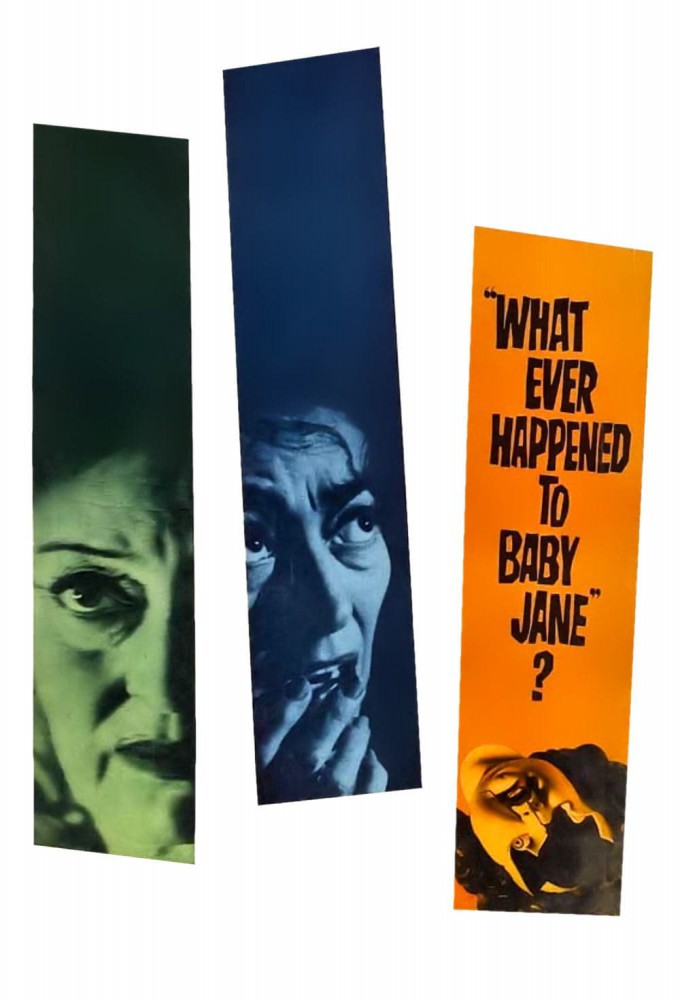
In 1917, "Baby Jane" Hudson, a spoiled and capricious child actress, performs in vaudeville theaters across the country with her father, who acts as manager and piano accompanist. Highly successful, a line of porcelain dolls is made in Jane's image. Meanwhile, her shy older sister, Blanche, lives in her shadow. Treated with contempt by the haughty Jane and with cruel dismissal by her father, Blanche is given weak apologies by her mother.
As the sisters reach adulthood, their situations reverse. Jane's performance falls out of fashion, and her career declines as she descends into alcoholism; Blanche becomes an acclaimed Hollywood actress. Mindful of a promise to their mother, Blanche attempts to maintain a career for Jane, prevailing on her film's producers to guarantee acting roles for Jane. One evening in 1935, Blanche's career is cut short when she is paralyzed from the waist down in a mysterious car accident that is unofficially blamed on Jane, who is found three days later in a drunken stupor.
By 1962, Blanche and Jane live together in a mansion purchased with Blanche's film earnings. Blanche's mobility is limited by reliance on a wheelchair and the lack of an elevator to her upstairs bedroom. Jane has become a grotesque, mentally unstable alcoholic who regularly abuses Blanche. When Blanche's old films begin airing on television, renewing her popularity among her fans, Jane becomes increasingly jealous and resentful. She fixates on the success and adoration she once had as a child star, deciding to revive her old act with hired pianist Edwin Flagg. When Blanche informs Jane she intends to sell the house, Jane correctly suspects Blanche will commit her to a psychiatric hospital once the house is sold. She removes the telephone from Blanche's bedroom, cutting her off from the outside world.
During Jane's absence, Blanche desperately drags herself down the stairs and calls her doctor for help. Jane returns to find Blanche on the phone, beating her unconscious before mimicking Blanche's voice to dismiss the doctor. Abruptly firing the housekeeper, Elvira, Jane ties Blanche to her bed and locks her in her room. While Jane is away, the suspicious Elvira sneaks into the house and attempts to access Blanche's room. Concerned by the lack of a response, Elvira starts to remove the door's hinge pins with a hammer. Upon returning home and being threatened with a call to authorities, Jane reluctantly gives Elvira the key. As Elvira enters Blanche's room, Jane strikes and kills Elvira with the hammer. Edwin comes by the house, but Jane refuses to answer the door. That night, she uses Blanche's wheelchair to move Elvira's body to her car.
A few days later, the police inform Jane that Elvira's cousin has reported her missing. Jane panics and prepares to leave, taking Blanche with her. Before they can go, police escort an inebriated Edwin to the house and leave him there. Upon discovering Blanche bound to her bed, Edwin flees and notifies the authorities. In a fit of infantile regression, Jane takes Blanche to a beach where she sang as a child.
The next morning, the radio news reports Elvira's murder and Blanche's condition, and the police are on the lookout. Weakened and near death, Blanche confesses to Jane that she caused her own accident. On the night in question, angry with her drunken sister for mocking her at a party, Blanche tried to run Jane over. Blanche's spine broke when her car struck the gates outside their mansion, and she dragged herself in front of the car's hood to stage the accident and frame Jane. Blanche took advantage of Jane's shock and subsequent bender, concealing the real cause of the accident from her, which subjected Jane to a life of guilt, loneliness, and servitude.
Now aware of the truth, a saddened Jane responds, "You mean all this time, we could have been friends?". When Jane gets them ice cream from a nearby refreshment stand, two police officers recognize her, asking her to lead them to Blanche. Attracting the attention of nearby beachgoers, Jane dodges the officers' inquiry and dances before the crowd of curious onlookers. The officers find Blanche nearby, rushing to attempt to save her.
Henry Farrell's novel, What Ever Happened to Baby Jane? was announced for publication on March 3, 1960. Three weeks later, producer Richard Rush was in talks to acquire the film rights, intending to cast Hugh O'Brian, Agnes Moorehead, and Jennifer West. However, the project stalled until September 1961, when Robert Aldrich came on board as director for producer Joseph E. Levine's Embassy Pictures. Funding was secured through Seven Arts Productions, with Warner Bros. Pictures handling distribution.
Reception
What Ever Happened to Baby Jane? was a box-office hit. During the week of November 21, 1962, it was the second-highest earning film release in the United States, and had fully recouped its production cost by November 18, 1962. By February 1963, the film had earned gross receipts of $4 million. It ultimately went on to gross a total of $9 million in theatrical rentals in North America, giving both Bette Davis and Joan Crawford their biggest hit in over a decade.
Legacy
The film's success spawned a succession of unrelated horror and thriller films featuring psychotic older women, later dubbed the "psycho-biddy" or "hagsploitation" subgenre. Among them are Aldrich's subsequent film which also starred Davis, Hush...Hush, Sweet Charlotte (1964); Lee H. Katzin's What Ever Happened to Aunt Alice? (1969); Curtis Harrington's Whoever Slew Auntie Roo? (1972) and What's the Matter with Helen? (1971).
What Ever Happened to Baby Jane? has been noted in the years since its release for its camp appeal.