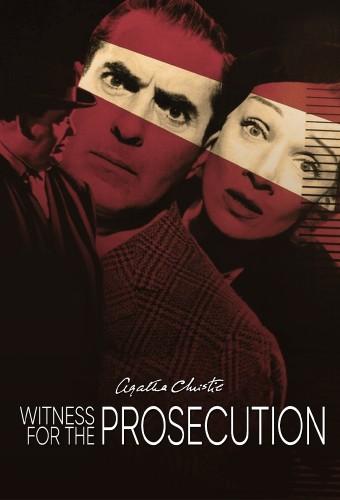
Senior barrister Sir Wilfrid Robarts is nearing retirement after a heart attack. He agrees to defend Leonard Vole, despite Nurse Plimsoll's objections and Sir Wilfrid's doctor having warned against taking stressful criminal cases. Leonard is accused of murdering Emily French, a wealthy, childless widow who fell in love with him and named him as the main beneficiary in her will. Despite the evidence, Sir Wilfrid believes his client to be innocent.
Sir Wilfrid speaks with Leonard's German wife, Christine, whom he finds cold and self-possessed; she provides Leonard with an alibi, but Sir Wilfrid warns her that juries often do not accept alibis given by spouses. Sir Wilfred is later shocked when Christine is called to give evidence against Leonard as a prosecution witness.
While a wife cannot be compelled to testify against her husband, it is revealed that her marriage to Leonard is invalid, as she was already married to another man, Otto Helm, still alive and living in Germany. She states that she never loved Leonard, and her conscience compels her to tell the truth. She explains that she met Leonard, a Royal Air Force sergeant serving in Berlin's British occupation zone, and went through a marriage ceremony with him solely to escape from Soviet-controlled territory. According to her testimony, Leonard arrived home after the time of the murder, and openly confessed that he had killed Mrs. French.
Sir Wilfrid fears that his client will be convicted and sentenced to hang. He is then unexpectedly contacted by a Cockney woman, who offers to sell him compromising letters written by Christine to a man named Max. The handwriting is genuine, and the woman appears to have a legitimate reason for providing the correspondence: Max, who had once been her lover, had attacked her, leaving her with facial scars. During cross examination, Sir Wilfrid reads the letters, which disclose a conspiracy between Max and Christine to frame Leonard. The jury acquits Leonard.
Sir Wilfrid admits that his victory seemed suspiciously easy, and is proved right when Christine returns to the courtroom to avoid an angry crowd waiting outside. She explains that, after Sir Wilfred's earlier warnings about alibis, she had decided to pose as a hateful, double-crossing wife. She wrote letters to a non-existent lover (Max) and impersonated the disfigured woman who passed them to Sir Wilfrid. Christine loves Leonard, but knew he was guilty; she told the truth about Leonard's confession in the witness-box, then used the false letters to discredit her own testimony. Sir Wilfrid is outraged, but the law of double jeopardy prevents any renewed prosecution of Leonard.
Leonard reveals he is having an affair with a much younger woman, and intends to abandon Christine. He smugly states that, though Christine will be tried for perjury, he and she are now even, having saved each other's lives. A devastated Christine grabs a knife and fatally stabs Leonard. As she is taken into custody, Sir Wilfrid decides to further delay his retirement to defend Christine.
Producers Arthur Hornblow and Edward Small bought the rights to the play for $450,000. The play was adjusted to emphasize the character of the defence barrister. Billy Wilder was signed to direct in April 1956. According to Wilder, when the producers approached Marlene Dietrich about the part, she accepted on the condition that Wilder direct. Wilder said that Dietrich liked "to play a murderess" but was "a little bit embarrassed when playing the love scenes."
Vivien Leigh was considered for the role of Christine Vole.
Reception
Witness for the Prosecution reached number one at the American box office for two consecutive weeks in February and March 1958. In its first year, the film earned $3.75 million in distributor rentals in the United States and Canada.
Leonard Vole: [stepping on it] I think I've found it.
Christine Vole: Step on it again. It's still breathing.
Miss Plimsoll: Shall we roll up the window, Sir Wilfrid?
Sir Wilfrid: Just roll up your mouth, you talk too much. If I'd known how much you talk I'd never have come out of my coma.
Miss Plimsoll: I almost married a lawyer once. I was in attendance when he had his appendectomy, and we became engaged as soon as he could sit up... and then peritonitis set in and he went just like that!
Sir Wilfrid: He…
Sir Wilfrid: Give me a match.
Leonard Vole: Sorry, I never carried them.
Sir Wilfrid: [to Mayhew] What? You said I'd like him.
Leonard Vole: But I do have a lighter.…
Leonard Vole: But this is England, where I thought you never arrest, let alone convict, people for crimes they have not committed.
Sir Wilfrid: We try not to make a habit of it.
Sir Wilfrid: Be prepared for hysterics and even a fainting spell. Better have smelling salts handy and a nip of brandy.
Christine Vole: I do not think that will be necessary. I never faint because I am not sure that I…