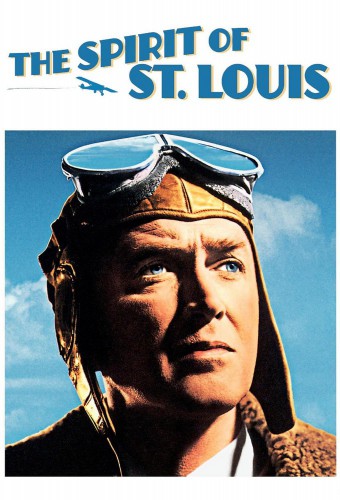
On May 19, 1927, after waiting a week for the rain to stop on Long Island, New York, pilot Charles A. "Slim" Lindbergh tries to sleep in a hotel near Roosevelt Field before his transatlantic flight from New York to Paris. His friend Frank Mahoney guards his hotel-room door from reporters. Unable to sleep, Lindbergh reminisces about his time as an airmail pilot.
In a flashback sequence, Lindbergh lands his old de Havilland biplane at a small airfield to refuel on the way to Chicago. Despite bad weather, he takes off, unaware that heavy snow has closed the Chicago landing field. Lindbergh is forced to bail out in a storm after running out of fuel. Recovering mail from his crashed DH-4, he continues to Chicago by train. A suspender salesman tells him that two airmen just died competing for the Orteig Prize for the first nonstop flight from New York City to Paris.
Lindbergh telephones Columbia Aircraft Corporation in New York from a small diner at the Lambert-St. Louis Flying Field. Quoted a price of $15,000 ($280,000 today) for a Bellanca high-wing monoplane, Lindbergh lobbies St. Louis financiers with a plan to fly the Atlantic in 40 hours in a stripped-down, single-engine aircraft. The backers are excited by Lindbergh's vision and dub the venture Spirit of St. Louis.
When the Bellanca deal falls apart because Columbia insists on selecting the pilot, Lindbergh approaches Ryan Airlines, a small manufacturer in San Diego, California. Frank Mahoney, the company's owner and president, promises to build a suitable monoplane in just 90 days. With Ryan's chief engineer Donald Hall, a design takes shape. To decrease weight, Lindbergh refuses to install a radio or other heavy equipment, even a parachute, and plans to navigate by "dead reckoning". With no autopilot function available, Lindbergh will not be able to sleep during the 40 hour flight. With the deadline pressing, Ryan workers agree to work around the clock, completing the monoplane in just 62 days. However, by the time it is completed, Nungesser and Coli have begun their attempt, which is ultimately tragically unsuccessful.
Lindbergh flies The Spirit of St. Louis to New York, stopping at Lambert Field (St. Louis Lambert International Airport) on the way to show the aircraft to his investors. He prepares for the flight at Roosevelt Field, ensuring that 450 gallons of fuel is on board for the long flight. In the cramped cockpit, which does not allow direct forward view, the magnetic compass must fit above his head; a young woman offers her compact mirror, which is attached with chewing gum so that Lindbergh can read the compass. Mahoney secretly slips a Saint Christopher medal into a bag of sandwiches on board.
As the weather clears, The Spirit of St. Louis trundles down the muddy runway and barely clears power lines and treetops. A newspaper headline reads: "Lindy Is Off!" Every hour, Lindbergh switches fuel tanks to keep the airplane's weight balanced. As he flies over Cape Cod, Lindbergh realizes that he has not slept in 28 hours. He recalls past times when he had slept on railroad tracks, short bunk beds, and under a windmill. When he begins to doze, he is awakened by a fly. Over Nova Scotia, he sees a motorcyclist below, remembering his own Harley-Davidson motorcycle that he had once traded as partial payment for his first aircraft, a World War I war-surplus Curtiss Jenny.
Over the seemingly endless Atlantic, Lindbergh remembers barnstorming across the Midwest in a flying circus. After 18 hours, ice forms on the wings and engine, and the aircraft begins losing altitude. Lindbergh changes course and the ice breaks off in the warmer air; the engine, which had stopped, is restarted. Back on course, his compasses begin malfunctioning, forcing him to navigate by the stars. By dawn, he falls asleep, and the monoplane gradually descends in a wide spiral toward the ocean. Sunlight reflecting off the compact's mirror hits his eyes and awakens him just in time to regain flight control.
Seeing a seagull, Lindbergh realizes that he is close to land. He tries without success to hail a fisherman below. Sighting land, he determines that he has reached Dingle Bay, Ireland. Pulling out a sandwich from a paper bag, Lindbergh discovers the hidden Saint Christopher medal and hangs it on the instrument panel. Crossing the English Channel and the coast of France, Lindbergh follows the Seine up to Paris as darkness falls.
Finally seeing the city lights ahead of him, Lindbergh approaches Le Bourget Airfield in the dark, becoming disoriented by panning spotlights aimed into the sky. He glimpses strange movements and lights below, in reality huge crowds of people and traffic in and around Le Bourget. Confused by this chaos, Lindbergh begins his landing approach, quickly becoming panicked. As he goes lower, he whispers "Oh, God, help me!"
Landing safely and bringing The Spirit of St. Louis to a full stop, Lindbergh is rushed by hordes of people while sitting in the plane. As flash powder ignites and photos are taken, Lindbergh is carried triumphantly on people's shoulders toward a hangar. An exhausted Lindbergh eventually realizes that the crowds, numbering 200,000, are cheering for him and his achievement. On returning to New York City, Lindbergh, having now become a national hero, is given a huge ticker tape parade, with four million people lining the parade route.
Billy Wilder was looking to collaborate on the script with a writer but had not found someone he would work with. He was reading an article in the newspaper by Colin Goring on bridge, and next to the column was a review of one of Wendell Mayes' television plays. This led to Mayes being hired to work on the script. Mayes said, "We simply wrote a screenplay together, in a room together, walking around, talking it out, We would write a scene just as you would imagine a scene would be written. I would say, "Suppose he says this . . .
Reception
The film garnered mixed reviews, with Bosley Crowther at The New York Times praising the "... exciting and suspenseful episodes" while noting that Stewart's performance as Lindbergh did not convey the human side well:"We see very little of his basic nature, his home life or what makes him tick. As Mr. Stewart plays him, with his usual diffidence, he is mainly a type.