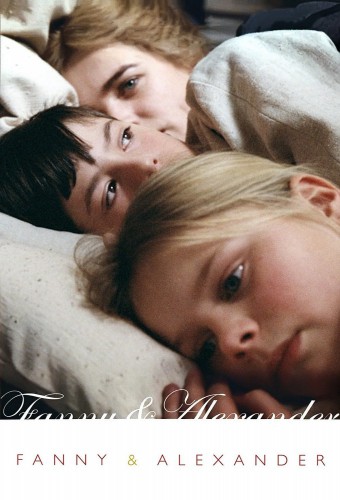
In 1907, young Alexander, his sister Fanny, and their well-to-do family, the Ekdahls, live in a Swedish town, running a moderately profitable theatre. At Christmastime, the Ekdahls hold a Nativity play and later a large lively Christmas party. The siblings' parents, Emilie and Oscar, are happily married, with Oscar managing the theatre on behalf of the matriarch, Helena Ekdahl. Helena, a widow, reminisces humorously with long-time family friend, Isak Jacobi, about the time her husband caught them in flagrante delicto in an embrace, fondly remembering how their friendships endured. The siblings' womanizing uncle, Gustav Adolf, carries on with the nursemaid, Maj, with the forbearance of his wife, Alma, who jokes with the women in the family about her husband’s latest fling. The siblings' other uncle, Carl, privately bemoans himself humorlessly as a failure to his tolerant wife, Lydia. The joyful Christmas festivities at the Ekdahls abruptly end when Oscar suddenly dies from a stroke.
Shortly thereafter, Emilie marries Edvard Vergérus, the local bishop and a widower, who supported Emilie in her deep grief, advantageously pressing his suit. Emilie and her children move into the Vergérus home where he lives with his mother, sister, aunt, and maids. The children's stepfather, the bishop Edvard, soon reveals himself to be a strict and controlling authoritarian. The relationship between the bishop and Alexander is especially cold, as Alexander invents stories, for which Edvard punishes him severely. Quickly realizing her mistake, Emilie asks for a divorce, which Edvard will not consent to; though she may leave the marriage, this would be legally considered desertion, placing the children in his custody. Meanwhile, the rest of the Ekdahl family has begun to worry about their condition, and Emilie secretly visits her former mother-in-law, Helena, revealing she is pregnant.
During Emilie's absence, Edvard confines the children to their bedroom, ostensibly for their safety. There, Alexander shares a story, claiming he was visited by the ghosts of the Vergérus children, who revealed the bishop was responsible for their deaths. The maid Justina reports the story to Edvard, who responds with corporal punishment. After Emilie returns, the Ekdahl family friend, Isak Jacobi, helps smuggle the children from the house. They live temporarily with Isak and his nephews in their store.
Emilie's former brothers-in-law confront Edvard to negotiate a divorce, using the children, the bishop's debts, and the threat of a public scandal for leverage, but Edvard is unmoved. Emilie, now in the later stages of her pregnancy and still living with Vergérus, refuses to restore the children to Edvard's home. Emilie manipulates Edvard into drinking a large dosage of her bromide sedative from her cup. As the medication takes effect, she explains to him that she intends to flee the home as he sleeps. He drowsily threatens to follow her family and ruin their lives but falls unconscious. After Emilie escapes, Edvard's dying Aunt Elsa accidentally overturns a gas lamp, setting her bedclothes, nightgown, and hair on fire. Engulfed in flames, she runs through the house, seeking Edvard's help, but he, too, is set aflame. Although partially incapacitated by the sedative, he disentangles himself from Aunt Elsa, but he is badly burned and dies shortly thereafter.
Alexander had fantasised about his stepfather's death while living with Isak and his nephews, Aron and Ismael Retzinsky. The mysterious Ismael explains that fantasy can become true as he dreams it.
The Ekdahl family reunites for the christening celebration of Emilie's and the late bishop's daughter as well as the extra-marital daughter of Alexander's uncle, Gustav Adolf, and the maid, Maj. Alexander encounters the ghost of the bishop who knocks him to the floor, and tells him, "You can never escape me." Emilie, having inherited the theatre, hands Helena a copy of August Strindberg's play A Dream Play to read and tells her that they should perform it together onstage. Initially scoffing at the idea and declaring Strindberg a "misogynist," Helena takes to the idea and begins reading it to a sleeping Alexander.
Director Ingmar Bergman conceived of Fanny and Alexander while working on his 1980 film From the Life of the Marionettes, and wrote the screenplay at Fårö in summer 1979. Bergman intended Fanny and Alexander to be his last feature film, but he wrote several screenplays afterwards and directed for television. He told the press he decided to retire, because, "I don't have the strength any more, neither psychologically nor physically".
Reception
There were large audiences in Sweden at showings of Fanny and Alexander, including at the five-hour cut, making it the most popular box-office film Bergman had in his native country. It had 374,208 admissions in France and 165,146 in Germany. This amounted to minimal presence in the French box-office.
Fanny and Alexander finished its run grossing $6,783,304 in North America.
Legacy
After ostensibly retiring from directing, Bergman completed After the Rehearsal in 1984. Bergman also conceived of a biographical project following his parents Erik and Karin Åkerblom, and in a press conference in August 1989, announced he planned a production that could be considered a follow-up to Fanny and Alexander and his 1987 autobiography The Magic Lantern. The resulting 1991–92 miniseries and film The Best Intentions was directed by Bille August and won the Palme d'Or at the 1992 Cannes Film Festival.