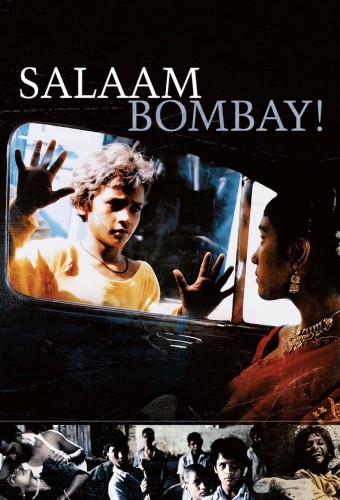
Before the start of the film, Krishna has set fire to his elder brother's motorbike in retaliation for being bullied by him. His angry mother has taken him to the nearby Apollo Circus and told him that he can only come home when he has earned 500 rupees to pay for the damage. Krishna agrees and starts working for the circus.
The film begins as the circus is packing up to move on to its next site. His boss asks him to run an errand, but when Krishna returns, he finds that the circus has left. Alone, with nowhere to go and without the money to repay his mother, he travels to the nearest big city, Bombay. As soon as he arrives, he is robbed of his few possessions. He follows the thieves, befriends them, and ends up in the city's notorious red-light area of Falkland Road, near the Grant Road railway station.
One of the thieves, Chillum, a drug pusher and addict, helps Krishna get a job at the Grant Road Tea Stall and becomes a mentor of sorts to him. Baba, a local drug dealer, employs addicts like Chillum. Baba's wife, Rekha, is a prostitute, and they have a little daughter, Manju. Rekha is annoyed that she has to raise her daughter in such an environment. Baba had promised to start a new life elsewhere, but it is a promise that Baba cannot or will not fulfill.
Krishna gets a new name "Chaipau" and learns to live with it. His goal is still to raise the money he needs to return home, but he soon finds out that saving money in his new surroundings is next to impossible. To make matters worse, he has a crush on a teenage girl named "Sola Saal" (meaning "sixteen years"), who has been recently sold to the brothel. He sets fire to her room and attempts to escape with her, but they are caught. The fire causes Krishna to get a severe beating, while Sola Saal, who is considered valuable since she is still a virgin, denies starting the fire and tearfully tries to resist her enslavement. The madame of the house asks Baba to "tame her," which Baba agrees to do.
Meanwhile, Krishna, as well as working at the tea stall, works odd jobs to save some money and help Chillum, who cannot survive without drugs, especially after being sacked by Baba after a disastrous interview with a foreign journalist. Eventually, one of these odd jobs costs Krishna his job at the tea stall. To get more money, Krishna and his pals rob an elderly Parsi man by breaking into his house in broad daylight. Krishna eventually finds out that the money he has saved has been stolen by Chillum for drugs, with which Chillum has overdosed and died.
One night, while returning home from work with friends, Krishna and Manju are apprehended by the police and taken to a juvenile home. Krishna escapes and goes back to his world. He finds that a new recruit in Baba's drug business has taken Chillum's place and name. Krishna meets Sola Saal and tries to convince her to run away with him. She reveals that she is charmed by Baba and no longer interested in Krishna; she is driven away to service her first 'client'. Meanwhile, Rekha is told that the authorities will not release their daughter because the mother is a prostitute. An angry Rekha decides to leave Baba, but Baba beats her as punishment. She is saved by the timely intervention of Krishna who, in a fit of rage, kills Baba and attempts to run away with her, but they become separated in a parade honoring Ganesh. The film ends with a slow zoom in on Krishna's dejected face.
Nair records that the initial inspiration came from the spirit of Bombay's street children. Her ideas developed when she researched their lives with her creative partner Sooni Taraporevala. From the beginning, they decided that real street children would play in the film since the combination of childhood and knowledge in their faces would be hard to find among professional child actors.
Nair was also inspired to make the film after watching Héctor Babenco's 1981 drama Pixote.
Reception
Salaam Bombay! received mainly positive reviews from critics who commented on the cultural and social impact of the film. On the film review aggregator website Rotten Tomatoes, the film has an approval rating of 94% based on 31 reviews. The site's critical consensus reads, "Salaam Bombay! examines life in a part of the world that many viewers have never visited - but does so with enough compassion and grace to make them feel as if they have." Metacritic, which uses a weighted average, assigned the film a score of 79 out of 100, based on 18 critics, indicating "generally favorable" reviews.