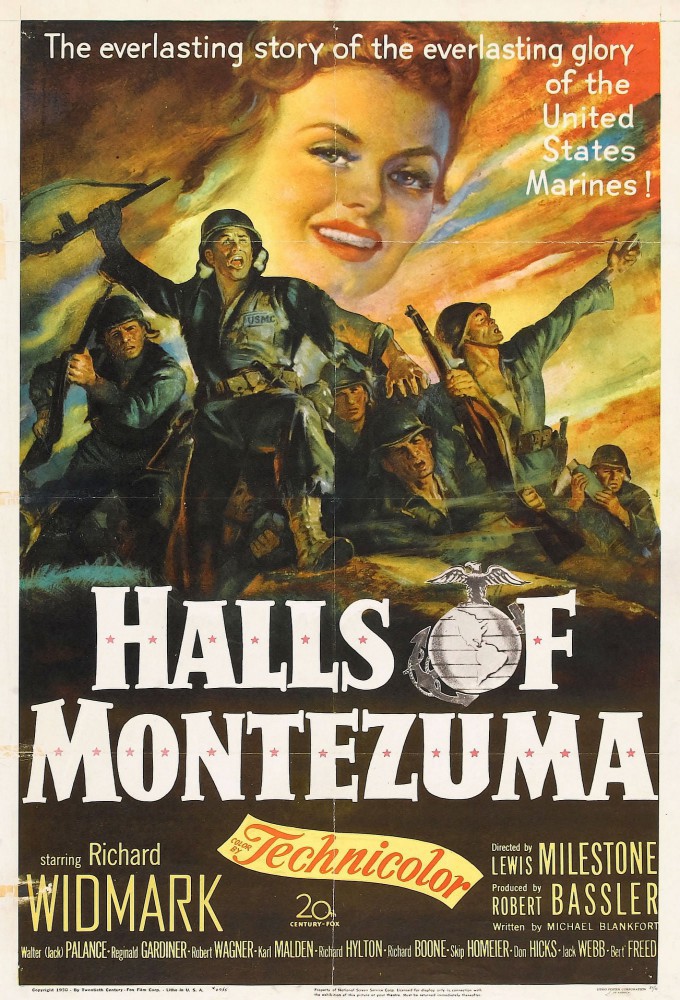
During World War II, a Marine battalion prepares to land on a Japanese-held island in the Pacific. Lieutenant Colonel Gilfillan orders the men to take prisoners in order to gain information about Japanese fortifications. Below deck, veteran Lieutenant Carl A. Anderson reassures frightened Corporal Stuart Conroy that he has shown courage before and can do so again, Anderson having been a science teacher before the war, and Conroy had been one of his students. In the landing boat heading to shore, Navy corpsman C. E. "Doc" Jones is worried because Anderson has been suffering from migraine for months, receiving painkillers from Doc. Anderson leads the men as they hit the beach. They try to take a ridge of hills but are deterred by a sudden Japanese rocket attack, during which his radio operator Private First Class Coffman, whom Anderson pulled out of the drink at Tawara is killed. Anderson meets with other officers at battalion headquarters, where Gilfillan informs them that he has received orders to stop the rockets within nine hours, before the next assault on the hills. He assigns Anderson's platoon the task of capturing Japanese prisoners to interrogate in an effort to learn the exact origin of the rocket fire. The colonel assigns Sergeant Johnson, an expert in Oriental languages and culture, to assist Anderson.
Among those whom Carl selects for his task, he includes his six of his most battle-hardened veterans, the last of his original men from 42 on Guadalcanal, Pigeon Lane, Slattery, Doc, Conroy, Sergeant Zelenko, Riley 'Pretty Boy' Duncanon and a replacement named Whitney, bringing along war correspondent Sergeant Dickerman as well, under Gilfillan's orders. Guided by Johnson, he leads them on patrol to a Japanese-held cave, where they are ambushed, resulting in Zelenko being blinded. Anderson's men capture five Japanese soldiers, including a shell-shocked old man, and kill the others. However, during their return to battalion headquarters, their number is reduced. Doc, the corpsman, dies of wounds, and Lane accidentally kills Pretty Boy when tries to stop him killing the prisoners, only for Pretty Boy to pull his rifle, making it misfire and kill him. Anderson, Johnson, Conroy, Slattery, Lane, Whitney and Dickerman are the only fully able-bodied survivors of the patrol. Anderson takes his prisoners to headquarters, but one Japanese officer commits seppuku. Later, Anderson and Johnson learn that one of the prisoners is a highly educated Major disguised as a private. After questioning him, they determine the location of the rockets.
A map expert at headquarters matches the location. Anderson's mission is thus accomplished, and Colonel Gilfillan offers his grateful thanks. But as Anderson returns to the platoon, he learns that Conroy has been killed from Slattery. Anderson is shocked the most by this death, and is disturbed by the news and questions the meaning of his sacrifice. In response, Dickerman reads aloud a note that Doc had given to him. Anderson, inspired by Doc's appeal that he remain strong for the other men, destroys his painkillers with the butt of his weapon. He leads his men in another assault on the Japanese, and Navy F4U Corsairs smash the Japanese rocket positions.
Dana Andrews, Anne Baxter and Paul Douglas were originally set to star in the film but did not become members of the cast.
The film used various locations around Camp Pendleton and the adjacent Pacific coast for the landing scenes. The Marines also provided accurate military equipment, such as weapons, tanks and uniforms, and provided the manpower to create the logistics of a wartime Marines battalion. The Marines assigned Major George A. Gilliland, the recipient of two Bronze Stars and a Purple Heart, as a technical advisor for the film.
Reception
In a contemporary review for The New York Times, critic Bosley Crowther called the film "a remarkably real and agonizing demonstration of the horribleness or war" and wrote:Pulling no punches in recording the dirty and gory details of beach-crashing, foot-slogging warfare and what it does to the minds and emotions or men, this Technicolored drama about a strike by United States Marines against an island in the Pacific is one of the best of the latter-day war films. And when we say that, we are commending not only the technical skill and the unrelenting candor of those who did the job, but also