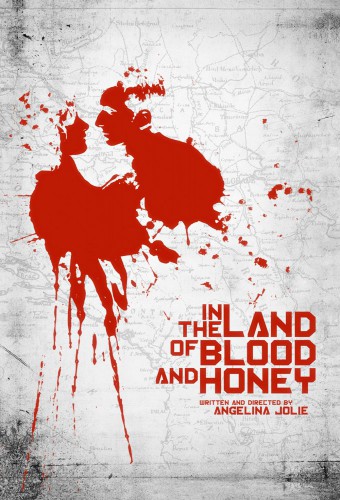
In Sarajevo, 1992, Ajla Ekmečić is an ethnic Bosniak artist and lives with her sister, Lejla, who is a single mother of a baby boy. One evening, she meets her boyfriend, ethnic Serb police officer Danijel Vukojević, at a club. They enjoy the evening together, but many of the patrons are killed and Danijel is badly injured when the club is destroyed by artillery fire, signifying the opening salvo of the Bosnian War.
Some months later, Ajla and Lejla prepare to flee the now besieged city, but their neighborhood is occupied by the Army of Republika Srpska before they can escape. The men are separated from the women to be executed while Ajla and several other younger, more attractive women are taken away on buses to a Serb rape camp.
In the camp, the soldiers instruct the women on what life will be like and then ask the women what sort of duties they can perform. A doctor named Esma volunteers to perform medical services. Another woman says she can sew; rather than use her skills, an officer rapes her in front of the other women to demoralize them. Before another soldier can do the same to Ajla, the camp's commander takes her away, where it is revealed he is none other than Danijel.
The former couple struggle to grasp the magnitude of their predicament, especially given that inter-ethnic relationships are forbidden, and any evidence of such a relationship could compromise both Danijel and his father Nebojša, a General of the VRS Main Staff. Danijel tells Ajla that to shelter her from sexual abuse at the hands of the other soldiers, he has said that she is his "personal property." Danijel quickly learns he is to be transferred to another military base in Sarajevo, and tells Ajla how to escape in his absence. She succeeds the second time.
Ajla shelters herself in the forest outside the city, where she is found by Bosniak guerrilla forces, who take her back to their camp. In the camp, she happily reunites with Lejla, though this happiness is short-lived when Lejla informs her that her baby was murdered by Bosnian Serb forces some months earlier, sending her into inconsolable grief. Over a campfire, the guerrillas lament the paradoxical insanity of the war, one in particular pointing out that despite the events of the war, he cannot hate all Serbs as his mother is a Serb. Lejla then agrees, and says she only hates the nationalistic Serbs. At this moment, it's found out that Ajla was Danijel's prisoner and lover, and the guerrillas concoct a plan for her to get captured by Danijel's men in order to gain proximity to him, and therefore act as a mole.
Falling for the bait, Danijel orders his men to capture Ajla under the guise of her being Danijel's painter. They end up rekindling their relationship, but Danijel's orders to his men to leave her alone are deemed suspicious. Thus, Nebojša learns of Ajla's existence and the special treatment she receives. While Danijel is at the front line, Nebojša visits Ajla and orders her to paint a portrait of him. While she paints, he criticizes the "Muslim decadence" of such a career, which contrasts starkly with his own mother, a lifelong farm labourer widowed during World War II. Ajla counters that her grandfather was a Partisan, and that he taught her as a child that the constituent peoples of Yugoslavia are all equal irrespective of ethnicity. Nebojša smirks at her observation then leaves her alone with a soldier, Petar, who violently rapes her.
Danijel returns from the front line to find a distraught Ajla crying in the shower. Believing that she has cheated on him, he assaults her, but then sees his father's unfinished portrait and knows what has transpired. Danijel lures Petar to a hill above the city, then kills him. He then confronts his father, who attacks him and berates him for disgracing the family, saying "your mother would turn over in her grave if she knew you liked to fuck Muslim whores."
A sense of normalcy descends on Ajla and Danijel up until the events at Srebrenica. As NATO forces prepare to launch an offensive against the Serbs, Nebojša convenes a meeting with other commanders at a church. Danijel tells Ajla of this meeting, as well as where it was located, and how he would send her a message if he turns out to be safe. At the church, Danijel narrowly avoids being killed alongside his father when a massive explosion destroys the church. Waking up in a haze from the explosion, Danijel sees Lejla across the street and realizes Ajla had betrayed him.
In conjunction with the bombing, ARBiH forces simultaneously launch a counter-offensive. Danijel hastily organizes his troops to halt their advance, but the Serb forces are decimated and most of his men are killed. Danijel returns to the now abandoned camp and finds Ajla patiently waiting. He confronts and beats her for helping to orchestrate the bombing, and she admits to it by apologizing—despite the apology seeming ingenuine. Danijel shoots and kills Ajla instantly.
Danijel wanders through the wreckage of the city, which is now near liberation. Perhaps realizing what the war has driven him to become, and that it was all for nothing, he breaks down in tears on the street in front of UNPROFOR personnel. He admits to being a war criminal, and it's presumed they subsequently arrest him shortly afterwards.
Jolie got the idea to write a script of a wartime love story after traveling to Bosnia and Herzegovina as a U.N. goodwill ambassador. While writing the script she consulted with Richard Holbrooke, a U.S. diplomat and high-ranking Clinton administration official who was one of the architects of the Dayton Agreement that put an end to the Bosnian War, General Wesley Clark, who was the director for strategic plans and policy on the United States Department of Defense's Joint Chiefs of Staff during the war, and Tom Gjelten, a foreign correspondent for NPR.
Reception
The film has received generally mixed reviews. The aggregate film review website Rotten Tomatoes shows that, based on 79 reviews, In the Land of Blood and Honey received a positive response from 57% of critics with an average rating of 5.86/10. Metacritic, which assigns a weighted average, gives the film a score of 56/100 based on 29 critics, indicating "mixed or average" reviews.