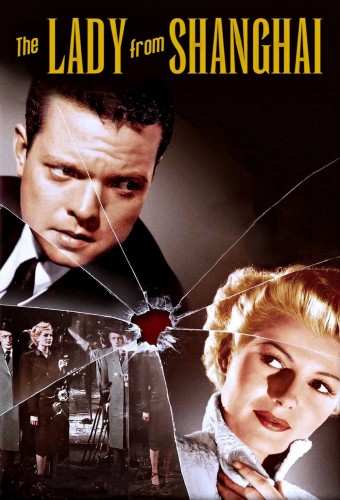
Irish sailor Michael O'Hara rescues a woman named Elsa when hooligans waylay her horse-drawn coach in Central Park. Escorting her to her car, Michael reveals he is a seaman and learns Elsa and her husband, criminal defense attorney Arthur Bannister, are newly arrived in New York City from Shanghai. They are on their way to San Francisco via the Panama Canal. Michael, attracted to Elsa despite misgivings, agrees to sign on as an able seaman aboard Bannister's yacht.
They are joined on the boat by Bannister's partner, George Grisby, who proposes that Michael "murder" him in a plot to fake his own death. He promises Michael $5,000 and explains that since he would not be actually dead and there would be no corpse, Michael could not be convicted of murder (reflecting corpus delicti laws at the time). Michael agrees, intending to use the money to run away with Elsa. Grisby has Michael sign a confession.
On the night of the crime, Sydney Broome, a private investigator who has been following Elsa on her husband's orders, confronts Grisby, having learned of Grisby's plan to murder Bannister, frame Michael, and escape by pretending to have also been murdered. Grisby shoots Broome and leaves him for dead. Unaware of what has happened, Michael proceeds with the night's arrangement and sees Grisby off on a motorboat before shooting a gun into the ground to draw attention to himself. A mortally wounded Broome warns Michael that he is being set up and Grisby intends to kill Bannister. Michael rushes to Bannister's office to find Bannister alive and Grisby dead. The police discover evidence implicating Michael, including his confession, and take him away.
At trial, Bannister acts as Michael's attorney. Upon learning of his wife's relationship with Michael, he ultimately takes pleasure in the suspicion that they will lose the case, while also indicates that he knows the real killer's identity. Before the verdict, Michael feigns a suicide attempt by swallowing Bannister's pain relief pills, and slips out of the building in the ensuing commotion. Elsa follows, and she and Michael hide in a Chinatown theater while they wait for Elsa's Chinese friends to arrive. Michael realizes that she killed Grisby, but passes out from the pills he took and is carried to an empty funhouse.
When Michael wakes, he deduces that Grisby and Elsa had been planning to murder Bannister, and for Grisby to appear to be the only culprit, who would then disappear using the un-provable murder ploy. Broome's involvement ruined the scheme and Elsa killed Grisby for her own protection. She had planned that with her husband and Grisby out of the way, and Michael cleared of murder, they could be happy together.
Bannister tracks Elsa down and engages in a shootout with her in a hall of mirrors. He is killed while Elsa is mortally wounded. Disillusioned and ignoring Elsa's pleas to save her life, Michael leaves with the knowledge that a letter Bannister had left behind will clear him of any crimes. He contemplates, "Maybe I'll live so long that I'll forget her. Maybe I'll die trying."
In the summer of 1946, Welles was directing Around the World, a musical stage adaptation of the Jules Verne novel Around the World in Eighty Days, with a comedic and ironic book by Welles, incidental music and songs by Cole Porter, and production by Mike Todd, who would later produce the successful film version with David Niven. When Todd pulled out from the lavish and expensive production, Welles financed it.
Reception
The film was considered a disaster in the U.S. at the time of its release, although the closing shootout in a hall of mirrors has since become one of the touchstones of film noir. Not long after the film's release, Welles and Hayworth finalized their divorce.
William Brogdon of Variety found the script to be "wordy and full of holes" while also noting that the "rambling style used by Orson Welles has occasional flashes of imagination, particularly in the tricky backgrounds he uses to unfold the yarn, but effects, while good on their own, are distracting to the murder plot."
Legacy
A remake of the film came close to production at the turn of the century from a screenplay written by Jeff Vintar, based both on Welles's script and the original pulp novel, produced by John Woo and Terence Chang, and starring Brendan Fraser, who wanted Michael Douglas and Catherine Zeta-Jones to co-star. Although the screenplay was considered highly successful, and Fraser was coming off the highly praised Gods and Monsters, the project was abandoned when the head of Sony Pictures, Amy Pascal, decided to concentrate on teen films.
Mrs. Elsa Bannister: You need more than luck in Shanghai.
Jake: What's a tough guy?...A guy with an edge...A gun or a knife, a nightstick, or a razor, somethin' the other guy ain't got. Yeah, a little extra reach on a…
Arthur: Of money. Before you start that novel Elsa says you're going to write, you'd better learn something. You've been traveling around the world too…
Elsa: He isn't really a steward...He's a detective, Michael. My husband hires him to watch me. He wants to fix it so I'll never be able to divorce him...I haven't a cent, Michael. He wants to cut me off without a cent.…