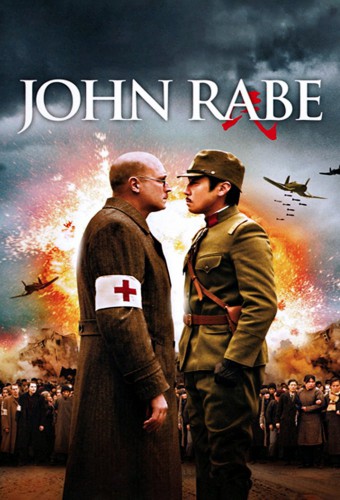
The film begins in Nanjing during late 1937, where German businessman John Rabe, director of the local Siemens subsidiary, and his wife Dora have resided for almost thirty years. The thought of transferring management to his successor Fliess and returning to Berlin is a substantial professional setback for him. During the farewell ball in his honour, Nanjing is bombarded by planes of the Japanese air forces. Rabe opens the company gate and saves the panicked civilians.
While the fires are being put out the next morning and the damages are inspected, the remaining foreigners in the city discuss what they can do in the face of the threat. Dr. Rosen, a German Embassy Attache of partly Jewish descent, reports about Shanghai where a safety zone was established for civilians. His suggestion of a similar zone is warmly supported by his superior, Ambassador Trautmann, and Valérie Dupres, director of the International Girls College. John Rabe is nominated as the chairman of the international committee, since he is a German "ally" of the Japanese. The committee meets, though with the initial reluctance of Dr. Robert O. Wilson, the American head doctor of a local hospital, who harbors ideological antipathy towards the German "Nazi" Rabe. The next day, Rabe sends his wife back to Germany. Tragically, the ship is bombed, and the passengers on board are killed, presumably including his wife.
Meanwhile, Japanese forces have captured many National Revolutionary Army soldiers during a battle outside of Nanjing. Nanjing is then brutally overrun. John Rabe and the international committee however manage to have the Nanjing Safety Zone recognized by the Japanese authorities. Hundreds of thousands seek refuge; more than anticipated and overstretching the committee's resources. Further atrocities follow, and every member of the committee tries their best to keep these innocent people safe. Mme. Dupres stoutly refuses to give up the Chinese soldiers hidden in the attic of the Girls College.
Under all the stress, Dr. Wilson and Rabe become friends, drinking, singing, and playing the piano together. The committee celebrates Christmas. Some packages have made it to them from the outside world. Rabe even gets an unmarked one. It is a Gugelhupf cake. Rabe faints as he realizes that his wife must have sent him this, his favorite cake, as a secret message that she is safe and well. His friends rush to his aid. Dr. Wilson discovers that Rabe is diabetic and has run out of insulin. The doctor manages then to procure some vital insulin from the Japanese authorities.
Life, and survival, become more desperate in the new year. Rabe offers his last savings to buy supplies. As Japanese troops march up to the gates of the zone, Chinese civilians form human shields together with the international committee. Japanese tanks are brought into position as well, but before a shot can be fired, the horn of a steamboat signals the return of Western diplomats and journalists.
The film ends with Rabe making his farewells. Carrying a small suitcase, he is escorted by a troupe of Japanese through the ruins of Nanjing to the harbour. There he is recognized and cheered by the Chinese. Finally, he is reunited with his wife on the pier.
Florian Gallenberger stated that although working with the Chinese censorship authorities was protracted, it was not impossible. The resulting film was deemed satisfactory. International Sino-Japanese politics was a more erratic interference. At one point concern about good relations because of a major gas exploration joint-venture caused production to be halted. When a Japanese school book was published without the inclusion of the Nanjing Massacre however, the go-ahead was given again.
Reception
In Japan, none of the major film companies were willing to watch the screening. Florian Gallenberger also confirmed those difficulties. The director was asked by one potential Japanese film distributor if they could remove all footage of Prince Asaka, who was commander of the Japanese forces in its final assault on Nanjing, but the director refused. Asaka was the presiding officer under which the order to "kill all captives" was issued, thus providing official sanction for the Nanjing Massacre.
The film, which did not have a theatrical release in Japan and was one of several made commemorating