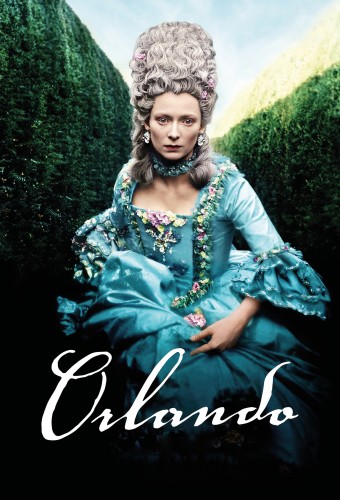
The story begins in the Elizabethan era, shortly before the death of Queen Elizabeth I in 1603. On her deathbed, the queen promises an androgynous young nobleman named Orlando a large tract of land and a castle built on it, along with a generous monetary gift; both Orlando and his heirs would keep the land and inheritance forever, but Elizabeth will bequeath it to him only if he assents to an unusual command: "Do not fade. Do not wither. Do not grow old." Orlando acquiesces and reposes in splendid isolation in the castle for a couple of centuries during which time he dabbles in poetry and art. His attempts to befriend a celebrated poet backfire when the poet ridicules his verse. Orlando then travels as English ambassador to the Ottoman Empire. After years of diplomatic service, he participates in a battle but flees after witnessing the first death. Waking seven days later, he learns something startling: he has transformed into a woman.
The now Lady Orlando comes home to her estate in Middle-Eastern attire, only to learn that she faces several impending lawsuits arguing that Orlando was a woman all along and therefore has no right to the land or any of the royal inheritance that the queen had promised. The succeeding two centuries tire Orlando; the court case, bad luck in love, and the wars of British history eventually bring the story to the present day (the early 1990s). Orlando now has a young daughter in tow and is in search of a publisher for her book. The literary editor who judges the work as "quite good" is portrayed by Heathcote Williams—the same actor who played the poet who had, earlier in the film, denigrated Orlando's poetry. Having lived a most bizarre existence, Orlando, relaxing with her daughter, points out to her an angel.
Director Potter described her approach to the adaptation as follows:
My task ... was to find a way of remaining true to the spirit of the book and to Virginia Woolf's intentions, whilst being ruthless with changing the book in any way necessary to make it work cinematically ... The most immediate changes were structural. The storyline was simplified [and] any events which did not significantly further Orlando's story were dropped.
The film contains some anachronisms not present in the novel. For example, upon Orlando's arrival in Constantinople in the year 1700, England is referred to as a "green and pleasant land", a line from William Blake's Jerusalem, which in reality was not written until 1804.
Potter argued that "whereas the novel could withstand abstraction and arbitrariness (such as Orlando's change of sex), cinema is more pragmatic." She continued,
There had to be reasons—however flimsy—to propel us along a journey based itself on a kind of suspension of disbelief. Thus, Queen Elizabeth bestows Orlando's long life upon him ... whereas in the book it remains unexplained. And Orlando's change of sex in the film is the result of his having reached a crisis point—a crisis of masculine identity.
At the end of the film, Orlando has a daughter, whereas in the novel she had a son. Potter said that she intended Orlando's breaking the fourth wall to be an equivalent to Woolf's direct addresses to her readers, and that this was her attempt at converting Woolf's literary wit into a more "cinematic" humour. One obvious similarity remained, however: The film ends in its present day, 1992, just as Woolf's novel ends in its present day, 1928.
When first pitching her treatment in 1984, Potter was told by "industry professionals" that the story was "unmakable, impossible, far too expensive and anyway not interesting." Nevertheless, in 1988 she began writing the script and raising money.
Potter saw Swinton in the Manfred Karge play Man to Man and said that there was a "profound subtlety about the way she took on male body language and handled maleness and femaleness." In Potter's words, Quentin Crisp was the "Queen of Queens ...
Reception
The film grossed $5.3 million in the United States and Canada. It also grossed $2 million in the United Kingdom; $1.9 million in Italy; $1.6 million in Germany and over $1 million in Australia. By October 1993, it had grossed $13 million.