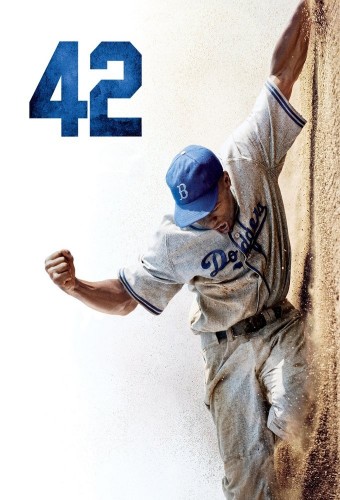
A montage depicts the end of the Second World War and the importance of baseball in the United States, a sport where African Americans play in segregated Negro leagues. The 1946 Major League Baseball season, meanwhile, featured 400 white players in 16 teams.
In 1945, Brooklyn Dodgers owner Branch Rickey seeks to recruit a black baseball player for his team. Reviewing potential candidates, Rickey suggests Jackie Robinson of the Negro leagues' Kansas City Monarchs. During a racially motivated confrontation at a gas station, Robinson is approached by Dodgers scout Clyde Sukeforth. Rickey tells Robinson the challenges of breaking the color line and emphasizes restraint in responding to provocations. Robinson agrees to join the Dodgers under these terms and proposes to his girlfriend, Rachel Robinson, who accepts.
In Daytona Beach, Florida, Robinson trains with the AAA affiliate farm team for the Brooklyn Dodgers: the Montreal Royals, managed by Clay Hopper. After performing well his first season, Robinson advances to the Dodgers and is trained as a first baseman in Panama City. Some Dodgers draft a petition refusing to play with Robinson, but are rebuffed by manager Leo Durocher, whom Rickey confides in. Robinson opens up to Wendell Smith, his black chronicler, saying he doesn't like needing people. Baseball Commissioner Happy Chandler suspends Durocher over his extramarital affair, and Robinson signs with the team and plays on the 1947 season's opening day; Rickey convinces former player Burt Shotton to take over as manager. Sometime later, Robinson and Rachel have a baby boy, whom Robinson vows to be there for.
On the field, Philadelphia Phillies manager Ben Chapman relentlessly taunts Robinson with racial epithets. In the dugout, Robinson angrily strikes his bat against the wall, breaking into tears. Rickey tells him that Robinson is too revered to retaliate. Fellow teammate Eddie Stanky defends Robinson, who scores the winning run. A Philadelphia hotel denies the Dodgers service, leading to an altercation between Robinson and Dixie Walker. When Chapman's behavior generates negative press for the team, Phillies' general manager Herb Pennock, who had earlier disapproved of Robinson playing in Philadelphia, requires Chapman to pose with Robinson for magazine photos. Teammate Pee Wee Reese sympathizes with Robinson, standing with his arm around Robinson's shoulders before a hostile crowd at Crosley Field. In a game against the St. Louis Cardinals, Enos Slaughter spikes Robinson on the back of the leg with his cleats. Robinson calms vengeful Dodgers, insisting they focus on winning the game. While Robinson is treated, Rickey tells him that Robinson inspired him to love baseball again.
Robinson hits a home run against Pittsburgh Pirates pitcher Fritz Ostermueller, who had earlier hit him in the head, helping the Dodgers clinch the National League pennant, sending them to the 1947 World Series. Rachel witnesses a Brooklyn street erupt in cheers while Wendell documents the achievements of Robinson, who confidently sprints toward home plate. An epilogue highlights Robinson's induction into the Baseball Hall of Fame alongside Rickey and Reese; Wendell becoming the first African American member of the Baseball Writers' Association of America; and the annual commemoration of Robinson's achievements, in which all players wear his number, 42, which remains retired across baseball. Inspired, a young Ed Charles later played for the 1969 World Series champion "Miracle Mets".
Spike Lee planned to write and direct The Jackie Robinson Story based on the life of Jackie Robinson and had it set up at Turner Pictures under his 40 Acres and a Mule Filmworks in 1995. The studio wanted to release it in 1997 to coincide with the 50th anniversary of Robinson's breaking of the color barrier, and courted Denzel Washington to star, but the project fell apart in 1996 over creative differences. In March 1997, Lee found favor with Columbia Pictures, who signed him to a three-year first-look deal.
Reception
42 grossed $95 million in the United States and $2.5 million in other territories, for a worldwide total of $97.5 million, against a production budget of $40 million. The film earned $27.3-27.5 million for its opening weekend, the best-ever debut for a baseball-themed film. This surpassed the previous highest opening of $19.6 million set by The Benchwarmers (2006) and Moneyball's $19.5 million (2011). 42 then made $17.7 million and $10.7 million on its second and third weekends, finishing second and third, respectively.
Branch Rickey: This is about baseball, Jackie. I see you starting in spring with our affiliate in Montreal. If you make it there, we'll try you down here... with the…
Wendell Smith: A man came by while you was asleep. He said more men were coming. It might have been those fellas. Mr. Rickey said to get you to Daytona Beach ASAP.
Leo Durocher: [Making noise with metal platter] Wake up, now ladies! Wake up! [To the Dodgers players] It has come to my attention that some of you fellas don't wanna play with Robinson. That you've even got a petition…