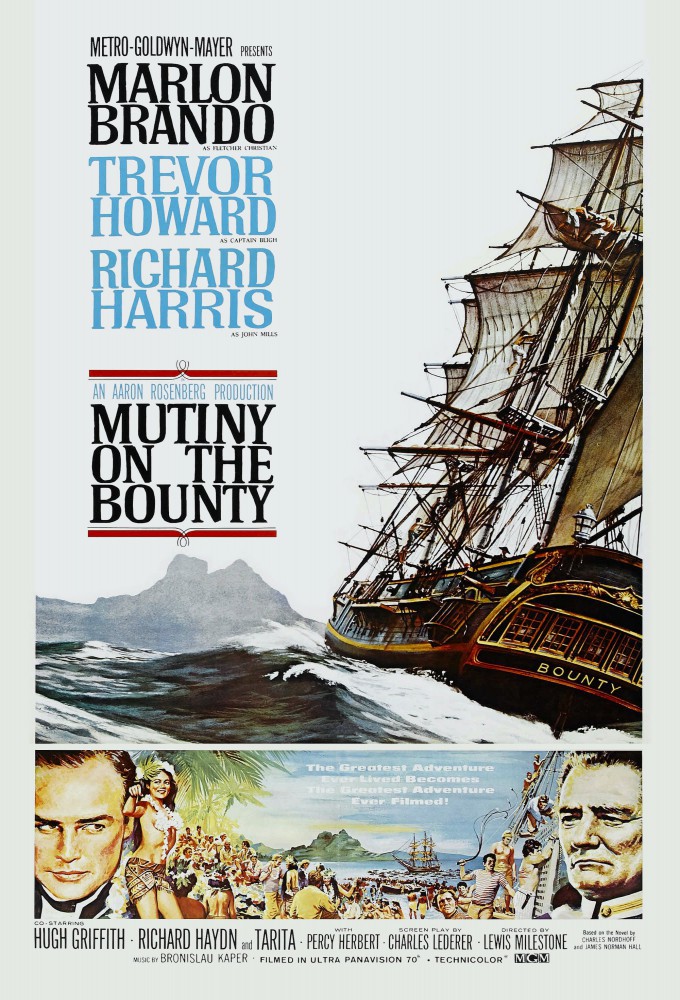
In 1787, the HMS Bounty sets sail from England for Tahiti under the command of William Bligh. His mission is to collect a shipload of breadfruit saplings and transport them to Jamaica, in the hopes that they can be used as cheap food for plantation slaves. Bligh is an experienced seaman and a competent officer, but also arrogant, dismissive of his green crew, and eager to complete the unpleasant voyage as quickly as possible.
The voyage gets off to a difficult start when a sailor, John Mills, is severely flogged for accusing Bligh of stealing cheese from the ship's stores to the disgust of Acting Lieutenant Fletcher Christian. Bligh tries to reach Tahiti sooner by attempting the shorter westbound route around Cape Horn. The strategy fails and the Bounty backtracks eastward, costing the mission much precious time. Bligh blames the men, cutting their rations and working them even harder.
When the Bounty reaches her destination, the crew revels in the easygoing life of the tropical paradise – and in the free-love practices of the Tahitian women. Christian himself is smitten with Maimiti, daughter of the Tahitian king. Bligh's agitation is further fueled by learning that the dormancy period of the breadfruit means more wasted months until the plants can be potted. As departure day nears, three men, including Mills, attempt to desert but are caught by Christian and clapped in irons by Bligh.
Bligh decides to take twice as many plants as planned for, ordering the crew to be allotted less water so they can be watered properly. A thirst-stricken crewmember falls to his death, and his mate is fatally keelhauled for striking Bligh in anger. Mills taunts Christian, trying to egg him on to challenge Bligh. When a third man becomes gravely ill from drinking seawater, Christian attempts to give him fresh water in violation of the Captain's orders. Bligh beats Christian when he ignores his second order to stop. In response, Christian backhands Bligh. Bligh informs Christian that he will be tried and likely hanged when they reach port.
With nothing left to lose, Christian seizes command of the ship and sets Bligh and a group of loyalists adrift in the longboat with a compass and meager rations, telling them to make for the island of Tofua. Bligh, bent on revenge, avoids Tofua and the rest of the islands by lying to his loyalists about the locals there practicing cannibalism, and instead crossing the Pacific westward in order to reach the Dutch colony of Kupang at Timor. He returns to Britain with remarkable speed and weeks later, a court-martial exonerates Bligh of any misdeeds for the loss of the Bounty and recommends an expedition to arrest the mutineers and bring them to trial. To Bligh's dismay, however, the court also determines that his appointment to command Bounty was a mistake. This conclusion is based on the fact that several superb officers with commendable records participated in the mutiny against him.
Christian sails back to Tahiti to pick up supplies, Maimiti and the girlfriends of the crew. They sail for a permanent home until reaching Pitcairn Island, which is marked incorrectly on British naval charts and would therefore be impossible to find. However, once on Pitcairn, Christian decides to sail home, fearing that Bligh will be exonerated without his testimony. In response, Mills orders the Bounty set aflame while Christian is searching for Bligh's sextant. The mortally burned Christian escapes and dies next to Maimiti as the flaming Bounty sinks.
Following the success of 1935's Mutiny on the Bounty, director Frank Lloyd announced plans in 1940 to make a sequel that focused on Captain Bligh in later life, to star Spencer Tracy or Charles Laughton. No film resulted. In 1945 Casey Wilson wrote a script for Christian of the Bounty, which was to star Clark Gable as Fletcher Christian and focus on Christian's life on Pitcairn Island. This was never filmed. In the 1950s, MGM remade a number of their earlier successes in color and widescreen formats, including Scaramouche and The Prisoner of Zenda.
Reception
On the review aggregator website Rotten Tomatoes, 70% of 20 critics' reviews are positive, with an average rating of 6.5/10. The website's consensus reads: "a visually splendid but notoriously bloated spectacle."
Metacritic, which uses a weighted average, assigned the film a score of 48 out of 100, based on 7 critics, indicating "mixed or average reviews".
Bosley Crowther of The New York Times wrote: "There's much that is eye-filling and gripping as pure spectacle", but criticized Marlon Brando for making Fletcher Christian "more a dandy than a formidable ship's officer ...
Legacy
Marlon Brando fell in love with Tahiti and in 1966 acquired a 99-year lease on the Tetiaroa atoll. He married (unofficially, according to some sources) Tarita Teriipaia on August 10, 1962. They had two children: Teihotu Brando (born 1963) and Tarita Cheyenne Brando (1970–1995). Brando and Teriipaia separated in July 1972.
John Mills: There's no chance for people like us to go back to England, give Bligh a bad name and walk free men ourselves. And anyone who thinks otherwise hasn't got the sense that God gave geese.
Fletcher Christian: I was just thinking, sir, that our little errand for groceries might wind up in a page of naval history if we succeed in negotiating The Horn in the dead of winter.
Captain Bligh: In a civilised society, certain lewd intentions towards the female members of one's family would be regarded as a, well, as an insult. Do you follow me?