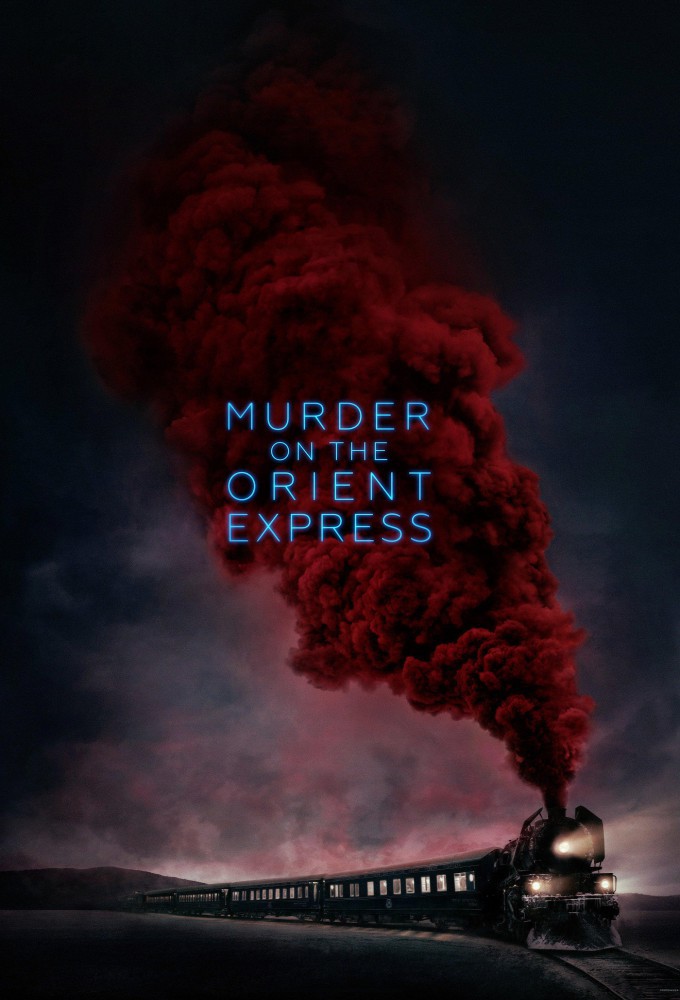
In 1934, famed Belgian detective Hercule Poirot solves a theft at the Church of the Holy Sepulchre in Jerusalem. Intending to return to London, his friend Bouc arranges accommodations for Poirot aboard the Simplon-route train, the Orient Express. Alongside Bouc, Poirot's fellow passengers include widow Caroline Hubbard; businessman Edward Ratchett, his manservant Edward Masterman and secretary Hector MacQueen; elderly Russian Princess Natalia Dragomiroff and her maid Hildegarde Schmidt; Hungarian diplomat Count Rudolf Andrenyi and his wife Elena; physician John Arbuthnot; Mary Debenham, a governess; Pilar Estravados, a Spanish missionary; Cuban-American car salesman Biniamino Marquez; and Gerhard Hardman, an Austrian university professor.
Having received threatening letters, Ratchett attempts to hire Poirot to protect him during the journey, but Poirot declines, not wanting to do business with a suspicious character. An avalanche derails the train's engine, stranding the passengers until a rescue crew can re-rail the locomotive. During the night, Poirot is awakened by strange noises in the hall next to his cabin and sees someone in a red kimono rushing down the aisleway. Ratchett is found murdered the following morning, stabbed a dozen times.
Poirot and Bouc work together to hunt the murderer. Poirot discovers the burned remnants of one of Ratchett's threatening notes, and from it deduces that Ratchett was really John Cassetti, the man responsible for the kidnap and murder of Daisy Armstrong, an infant child. Daisy's death caused her mother, Sonia, to go into premature labour, killing her and the baby, and out of grief her father, Colonel John Armstrong, killed himself. The family maid, Susanne, accused of complicity in Daisy's murder, also committed suicide.
Poirot finds a bloodstained handkerchief with a monogrammed "H", and a conductor uniform button in Mrs. Hubbard's cabin, leading him to find the uniform and kimono planted in his suitcase. Hubbard is later stabbed from behind and cannot identify the culprit. Poirot's interrogations of the passengers identifies direct connections between them and the Armstrong family. While interviewing Debenham, Poirot is shot in the shoulder by Arbuthnot, who confesses to the murder; Bouc incapacitates him before he can kill Poirot. However, Poirot quickly surmises that Arbuthnot, a former skilled army sniper, deliberately missed a killing shot.
Poirot gathers and confronts the passengers outside the train, uncovering their true identities:
MacQueen's district attorney father was pressured into prosecuting Susanne, but his career was destroyed when she was posthumously exonerated.
Hardman, in actuality a former police officer named Cyrus, was in love with Susanne.
Pierre Michel, the train's conductor, was Susanne's brother.
Arbuthnot and the terminally ill Masterman were Colonel Armstrong's comrades.
Marquez, Schmidt, and Estravados worked for the Armstrongs as their chauffeur, cook, and nursemaid respectively.
Countess Andrenyi is Sonia's sister, Helena.
Debenham was Daisy's and Helena's governess.
Dragomiroff was Daisy's godmother.
Hubbard is actually Linda Arden, a former stage actress, Sonia's and Helena's mother, and Daisy's grandmother.
Poirot concludes that they murdered Cassetti together, each stabbing him once. Hubbard takes the blame for planning the murder and recruiting the others. Debenham wore the kimono and Arbuthnot superficially stabbed Hubbard to mislead Poirot. Agreeing their cause was just, but compelled to tell the truth, Poirot challenges the passengers to shoot him dead so they will get away with the murder. Instead, Hubbard grabs the gun and attempts suicide, but realises it is unloaded; Poirot was testing the suspects' characters.
With the locomotive back on the tracks, Poirot surmises that justice is impossible in this case, as Cassetti deserved death. For the first time, Poirot must live with a lie and imbalance. He presents the lone escaped killer theory to the Yugoslavian police, allowing the others to remain on the train. As he disembarks, a British Army messenger delivers a note asking him to investigate a death on the Nile.
20th Century Fox announced the project in December 2013. Michael Green wrote the screenplay for a new film adaptation of Murder on the Orient Express. On 16 June 2015, it was reported Fox was in talks with Kenneth Branagh to direct. On 20 November 2015, it was announced that Branagh would both direct the film and star in the role of detective Hercule Poirot. He later said that he "enjoyed finding the sort of obsessive-compulsive in [Poirot] rather than the dandy."
In June 2016, Angelina Jolie entered into "talks" to join the cast of the film, in the role of Mrs Caroline Hubbard.
Reception
Murder on the Orient Express grossed worldwide a total of US$353 million against a production budget of US$55 million.
In North America, Murder on the Orient Express grossed US$103 million. It was released alongside Daddy's Home 2, and was projected to gross around $20 million from 3,341 cinemas in its opening weekend. The film made $10.9 million on its first day, including $1.6 million from Thursday night previews at 2,775 cinemas. It ended up grossing $28.7 million, finishing third at the box office, behind holdover Thor: Ragnarok, and Daddy's Home 2.
Hercule Poirot: I am of an age where I know what I like and what I do not like. What I like, I enjoy enormously. What I dislike, I cannot abide. For instance, the…