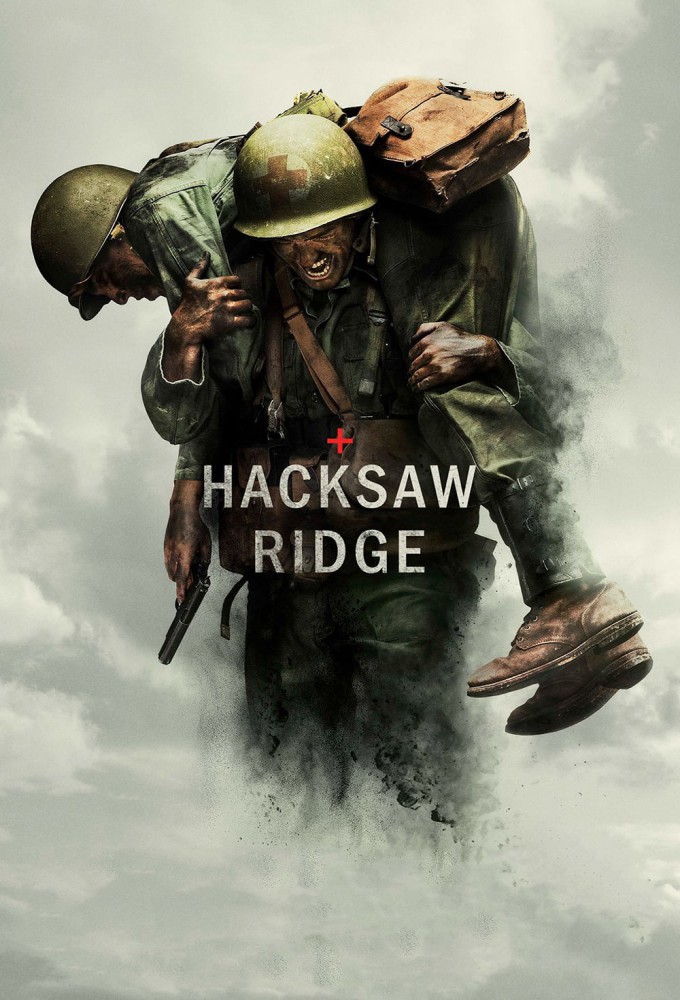
In 1929 Lynchburg, Virginia, young Desmond Doss nearly kills his brother while roughhousing. That event and his Seventh-day Adventist upbringing reinforce Desmond's belief in the commandment "Thou shalt not kill". Years later, he takes an injured man to the hospital and a romance develops with a nurse, Dorothy Schutte. Desmond tells her of his interest in medical work.
After the Japanese attack on Pearl Harbor brings the United States into World War II, Desmond enlists in the United States Army to serve as a combat medic. His father, Tom, a PTSD-ridden World War I veteran, is deeply upset by the decision. Shortly before leaving, Desmond and Dorothy get engaged.
Desmond is placed in basic training with the 77th Infantry Division under Sergeant Howell. He excels physically but becomes a pariah among his fellow soldiers for refusing to handle a rifle or train on Saturdays.
Howell and Captain Glover's attempts to discharge Desmond for psychiatric reasons under Section 8 are overruled, as Desmond's religious beliefs do not constitute mental illness. They subsequently try to drive him out with grueling labor tasks. After being beaten one night by his fellow soldiers, Doss refuses to identify his attackers, earning their respect.
Desmond's unit gets leave after basic training and Desmond intends to marry Dorothy, but his refusal to carry a firearm leads to an arrest for insubordination. Captain Glover and Dorothy visit Desmond in jail and try to convince him to plead guilty so that he can be released without charge, but he refuses to compromise his beliefs. He pleads not guilty at his court-martial but is found guilty. His father bursts into the tribunal before sentence can be pronounced with a letter from his former commanding officer, now a brigadier general, stating his son's pacifism is protected by the US Constitution and legal precedents. The charges are dropped, and Desmond and Dorothy are married.
Desmond’s unit is deployed to the Pacific Theater. During the Battle of Okinawa, they are tasked with ascending and securing the Maeda Escarpment ("Hacksaw Ridge"). The battle begins with heavy losses on both sides. Desmond saves the life of his squad-mate Smitty, who apologizes for doubting his courage. Desmond reveals that his aversion to holding a firearm stems from nearly shooting his drunken father, who threatened his mother with a gun. When a Japanese counterattack drives the Americans off the escarpment, Smitty is killed, and Howell and several of Desmond’s comrades are left injured on the battlefield.
Desmond hears the cries of dying soldiers and returns to save them, carrying the wounded to the cliff's edge and belaying them down by rope, each time praying to save one more. The rescue of dozens of wounded who had been presumed dead comes as a shock to the rest of the unit below. When day breaks, Desmond rescues Howell under heavy fire. Captain Glover apologizes for dismissing Desmond’s beliefs and states that they are scheduled to retake the ridge on Saturday but will not launch the next attack without him. Desmond agrees, but the operation is delayed until after he concludes his Sabbath prayers.
With reinforcements, they turn the tide of battle. In an ambush set by Japanese soldiers who pretend to surrender, Desmond saves Glover and others by deflecting enemy grenades. He is wounded by a grenade blast, but the battle is won. The Japanese commanding officers are shown committing seppuku as Desmond is lowered from the cliff, clutching the Bible that Dorothy had given to him.
The film closes with images of the real Desmond Doss being awarded the Medal of Honor by President Harry S. Truman for rescuing 75 soldiers at Hacksaw Ridge, and an interview with Desmond just before his death, recounting his experiences during the war.
Hacksaw Ridge was in development limbo for 14 years. Numerous producers had tried for decades to film Desmond Doss's story, including decorated war hero Audie Murphy and Hal B. Wallis.
In 2001, after finally convincing Doss that making a movie on his remarkable life was the right thing to do, screenwriter/producer Gregory Crosby (grandson of Bing Crosby) wrote the treatment and brought the project to film producer David Permut, of Permut Presentations, through the early cooperation of Stan Jensen of the Seventh-day Adventist Church, which ultimately led to the film being financed.
Reception
Hacksaw Ridge grossed $67.2 million in the United States and Canada and $113.4 million in other countries for a worldwide total of $180.6 million, against a production budget of $40 million.
The film opened alongside Doctor Strange and Trolls, and was projected to gross around $12 million from 2,886 theaters. It made $5.2 million on its first day and $15.2 million in its opening weekend, finishing third at the box office behind Doctor Strange and Trolls. The debut was on par with the $15 million opening of Gibson's previous directorial effort, Apocalypto, in 2006.
Sergeant Howell: [Open Scene] This is a personal gift from the government of the United States for each and everyone of you. A standard issue US-Rifle United States Army, 30 mm caliber, shutterfly, semi-automatic weapon…