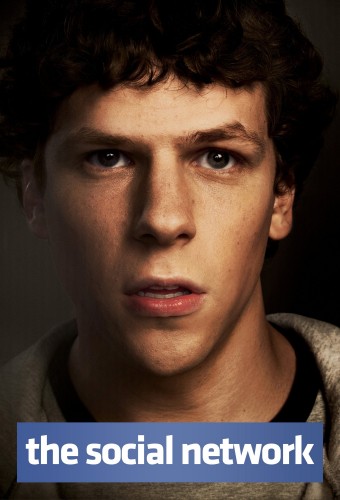
In intercut frame stories, two ongoing depositions play out: in one, Mark Zuckerberg is being sued by his former friend Eduardo Saverin, and in the other, he is sued by twins Cameron and Tyler Winklevoss.
On October 28, 2003, 19-year-old Zuckerberg, a Harvard University sophomore, is dumped by his girlfriend, Erica Albright. Returning to his dorm, Zuckerberg writes an insulting post about her on his LiveJournal blog. Zuckerberg creates a campus website called Facemash by hacking and downloading photos of female students from house face books, then allowing site visitors to rate their attractiveness. After traffic to the site crashes parts of Harvard's computer network, Zuckerberg is given six months of academic probation.
Facemash's popularity attracts the attention of the Winklevoss twins and their business partner Divya Narendra. The trio invites Zuckerberg to work on Harvard Connection, a dating-focused social network exclusive to Harvard students. Soon after, Zuckerberg approaches Saverin with an idea for "TheFacebook", a social networking website that would be exclusive to Ivy League students. As its CFO, Saverin provides $1,000 in seed funding so Zuckerberg can build the website, which quickly becomes popular. When they learn about TheFacebook, the Winklevoss twins and Narendra are incensed, believing Zuckerberg stole their idea and misled them by stalling development on the Harvard Connection. They raise their complaint with Harvard President Larry Summers, who dismisses it and sees no value in disciplining TheFacebook or Zuckerberg.
Saverin and Zuckerberg meet fellow student Christy Lee, who asks them to "Facebook me," a phrase that impresses them. As TheFacebook grows in popularity, Zuckerberg expands the network to Yale, Columbia, and Stanford. Saverin begins dating Lee, who arranges a meeting between him and Zuckerberg and Napster co-founder Sean Parker. Parker presents a "billion-dollar" vision for the company, impressing Zuckerberg. Saverin dismisses Parker as paranoid and delusional, except for his suggestion to rename TheFacebook to Facebook. Saverin deposits $18,000 into a new account as Zuckerberg relocates the company to Palo Alto on Parker's advice; Saverin remains in New York to work on business development while breaking up with Lee. Parker later moves into the house Zuckerberg uses as a base of operations and becomes more involved with the company, much to Saverin's annoyance.
After narrowly losing in the 2004 Henley Royal Regatta for Harvard against the Hollandia Roeiclub in United Kingdom, the Winklevoss twins discover that, through Parker, Facebook has expanded to Europe with Oxford, Cambridge and LSE, and decide to sue the company for intellectual property theft. Meanwhile, Saverin objects to Parker's decision-making at Facebook and freezes the company's bank account during the dispute, but relents when Zuckerberg reveals that they have secured $500,000 from angel investor Peter Thiel.
Saverin is invited to the company's new headquarters in San Francisco on the pretense of attending a business meeting and "millionth user party," but is enraged when he discovers that the new investment deal dilutes his share of Facebook from 34% to 0.03%, without diluting the ownership percentage of any other owner. He is also removed from the masthead as co-founder and CFO. He confronts Zuckerberg and Parker, vowing to sue as security removes him from the building. Shortly after, Parker is apprehended for cocaine possession with a minor at a party celebrating one million users. He attempts to blame Saverin, prompting Zuckerberg to cut ties with him.
Marylin Delpy, a junior lawyer for Zuckerberg, tells Zuckerberg they will settle with Saverin because the sordid details of Facebook's founding and Zuckerberg's callous attitude will make him unlikable to a jury. Alone, Zuckerberg sends Albright a Facebook friend request and repeatedly refreshes the page. Closing text reveals both cases were settled out of court, and Zuckerberg became the world's youngest billionaire.
Screenwriter Aaron Sorkin said, "What attracted me to [the film project] had nothing to do with Facebook. The invention itself is as modern as it gets, but the story is as old as storytelling; the themes of friendship, loyalty, jealousy, class and power". He said he read an unfinished draft of Ben Mezrich's The Accidental Billionaires when the publisher began "shopping it around" for a film adaptation. Sorkin added, "I was reading it and somewhere on page three I said yes. It was the fastest I said yes to anything ... They wanted me to start right away.
Legacy
Since its release, The Social Network has inspired involvement in start-ups and social media. Bob Lefsetz has stated that: "watching this movie makes you want to run from the theatre, grab your laptop and build your own empire," noting that The Social Network has helped fuel an emerging perception that "techies have become the new rock stars." This has led Dave Knox to comment that: "fifteen years from now we might just look back and realize this movie inspired our next great generation of entrepreneurs."
Mark Zuckerberg: I went to my friend for the money because that's who I wanted to be partners with. Eduardo was the president of the Harvard Investors Association, and he was also my best friend.